Famous Last Words: What History's Greatest Minds Said at the End

Curiosity Columnist
Last updated: August 2026
8 min read
TL;DR
Famous last words are one of history's most enjoyable unreliable sources. Socrates reportedly used his final breath to mention a rooster owed to the god of healing. Goethe is supposed to have asked for more light, though the account is disputed and other versions of his final hours exist. Emily Dickinson's last written line about the fog rising came from a letter, not a deathbed. Beethoven and Voltaire have several competing exit lines each. The pattern is not that people are unusually eloquent while dying. It is that survivors, biographers and translators improve the record. Reading these quotations carefully is a compact lesson in source criticism, and it is more fun than it sounds.
There is a particular kind of quotation that everyone half remembers and nobody has ever traced: the last thing a famous person said. They circulate because they are perfect, and they are usually perfect because somebody made them so.
This is not a morbid subject. It is a puzzle about how records get made. Every famous last line involves a dying person, a small number of exhausted witnesses, a gap of hours or years before anything is written down, and often a translator with opinions. That is a wonderful natural experiment in how history gets tidied.
Socrates and the rooster
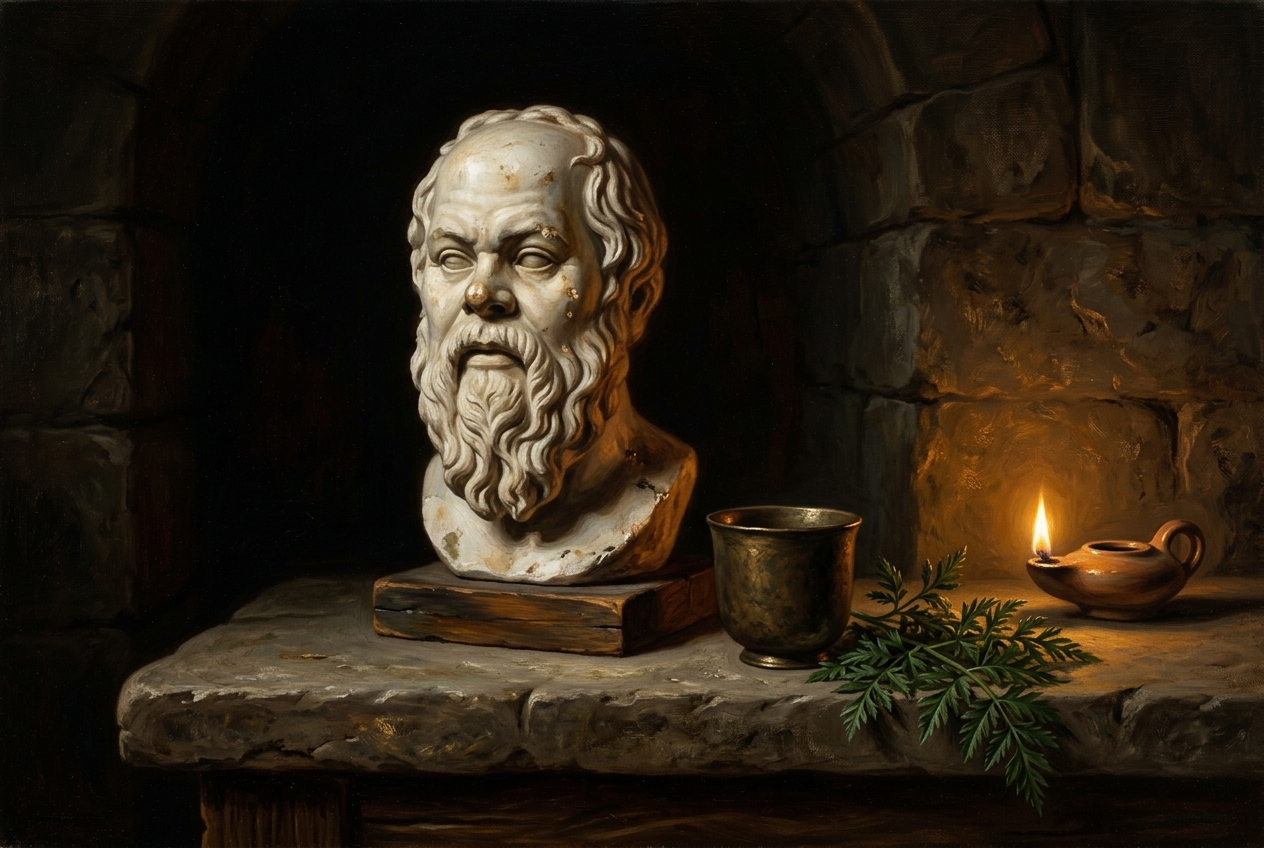
The most quoted deathbed remark in Western philosophy is also the strangest. In Plato's Phaedo, the hemlock is working its way up from Socrates' feet, his friends are gathered, and he uncovers his face to say that he owes a rooster to Asclepius and asks that the debt be paid.
Asclepius was the god of healing, and you sacrificed a rooster to him after recovering from illness. So the line is either a piece of ordinary piety, a joke about death being the cure for the illness of living, or a philosophical statement about the soul being released from the body. Scholars have argued all three for centuries, which is a lot of weight for one bird.
Here is the source problem. Plato tells us in the same dialogue that he was not present. The scene is unnervingly calm for hemlock poisoning, and it functions beautifully as the conclusion of an argument about the soul that the dialogue has been building for pages. It is a portrait consistent with a life, which is not the same thing as a transcript. We unpick the trial that led to it in why Socrates was sentenced to death, and it is the spine of a MindSnap collection called The Hemlock Hour.
Goethe and the light
Goethe died in Weimar in March 1832, and the phrase attached to him is Mehr Licht, more light. It is irresistibly good: the great figure of German letters, poet and natural scientist, asking with his last breath for more illumination.
The problem is that accounts of his final hours do not agree, and there is a mundane reading available. Some versions have him asking for a shutter to be opened, which is a request about a room rather than a statement about the human condition. Others record quite different final utterances, including domestic instructions. A longer version sometimes quoted has him saying more light on top of it, which reads suspiciously like an attempt to make the plain remark carry the profound one.
Notice what happened. A possible request for a shutter became a metaphor for enlightenment, because the metaphor is what the audience wanted from that particular deathbed. This is the single most common mechanism in the whole genre.
Dickinson and the fog
Emily Dickinson's famous ending is not a spoken line at all. In 1886, ill and near the end, she wrote a note to her cousins that read, in full and in her own punctuation, that she was called back. The line usually quoted as her last words, about having to go in because the fog is rising, comes from her correspondence and is generally described as the last thing she wrote.
It is characteristically hers: concrete, weather bound, quietly enormous. It is also a good illustration of category drift. A written phrase becomes a spoken one in retelling, because last words are supposed to be said aloud. Nobody lied. The story simply migrated to the shape it was expected to have.
Beethoven's competing exits
Beethoven died in Vienna in 1827 and has a small collection of last lines, which is itself the tell. The most repeated is a Latin phrase used to end a comedy, roughly applaud, friends, the comedy is finished. Another tradition has him remarking on a gift of wine arriving too late, saying pity, pity, too late. A third has a defiant gesture during a thunderstorm.
When a figure has three excellent last lines, the safest conclusion is that he has none that can be verified. Each version served somebody: the theatrical one for a dramatic genius, the wine one for a wry human being, the storm one for a Romantic hero. Biographers chose according to the Beethoven they were writing.
Voltaire, and the quips that are too good
Voltaire attracts apocryphal last words the way a magnet attracts filings, and the most famous is a supposed exchange with a priest who asked him to renounce Satan, to which he is said to have replied that this was no time to be making new enemies. It is superb. It is also exactly the sort of line his admirers would want him to have delivered, and the attribution is not secure.
A useful rule: the funnier and more perfectly timed a deathbed line is, the more work it is doing for somebody else's argument. Dying people are, on the whole, tired. Wit requires energy that the situation rarely supplies.
Why so many are probably invented
Four mechanisms account for most of it, and none of them require anyone to be dishonest.
- Reporting conditions. The witnesses are grieving, frightened and often few, the speech may be faint or broken, and nobody is taking dictation.
- Delay. Many accounts are written down years later, sometimes by people who were not in the room, and memory reliably smooths a fragment into a sentence.
- Myth making. A deathbed is the last chance to define a person, so the line gets adjusted to fit the life. Saints get piety, wits get jokes, poets get metaphors.
- Translation. Short phrases across languages are the most fragile of all. A German request about a shutter, a Latin theatrical tag, a Greek clause about a rooster: each acquires meaning in English that the original may not have carried.
This is exactly the terrain we walk in philosophy facts that sound made up, where the fun part is separating the durable anecdote from the well travelled one.
How to read a last line
You can apply a quick checklist to any famous quotation, deathbed or otherwise, and it takes about ten seconds.
- 1Who reported it, and were they in the room?
- 2How long after the event was it written down?
- 3Are there competing versions? Multiple good ones usually mean no reliable one.
- 4What language was it in, and who chose the English wording?
- 5Whose argument does the line conveniently support?
Run Goethe through that and the sheen comes off pleasantly rather than painfully. You lose a profound final utterance and gain something better: a clear view of how a sentence becomes famous. That habit transfers to headlines, statistics and quotations of every kind.
Keep the stories, hold them loosely
None of this means you should stop telling them. A well flagged uncertain story is more interesting than a confident false one, and saying the attribution is disputed makes you sound like someone who has read something rather than someone repeating a caption.
Disclosure, since we are about to mention our own product: MindSnap is our app. This is the kind of material we build daily two minute lessons from, across five flagship story driven collections plus unlimited topics you can request, and the sourcing caveats stay in rather than getting trimmed for tidiness. Browse what is there at Topics.
The best famous last words tell you very little about the person dying and a great deal about the people who survived to write them down.
Frequently asked questions

One snap tomorrow morning.
Two minutes in art, history, psychology, philosophy or economics, then the app tells you you're done.
Get MindSnap on iOSFree daily fact, forever. Pro is $9.99/month or $44.99/year.