Did Vermeer Use a Camera Obscura? An Old Mystery of Light

Arts & History Editor
Last updated: August 2026
9 min read
TL;DR
Vermeer's paintings contain optical oddities that look like the behaviour of a lens rather than the behaviour of an eye: beads of blurred light, foregrounds that fall out of focus, colours that shift the way projected images do. That has convinced many people he worked with a camera obscura. There is no document, no lens in his estate inventory, and no confession, and a very skilled painter could produce those effects deliberately. It remains an open question, and the way historians argue about it is a lesson in reasoning from incomplete evidence.
There are thirty-something paintings by Johannes Vermeer, no letters from him, no workshop notes, no pupils writing down what he said. He lived and died in Delft, left his widow in debt, and was largely forgotten for two centuries. Then the paintings came back into view and people started noticing something strange about the light.
Look closely at the bread in The Milkmaid. The highlights are not brushed like reflections on a crust. They sit on the surface as small round beads, slightly out of focus, as if the light had been softened before it reached the canvas. Art historians call these pointilles, and they are the kind of thing you see in a projected image rather than in a room.
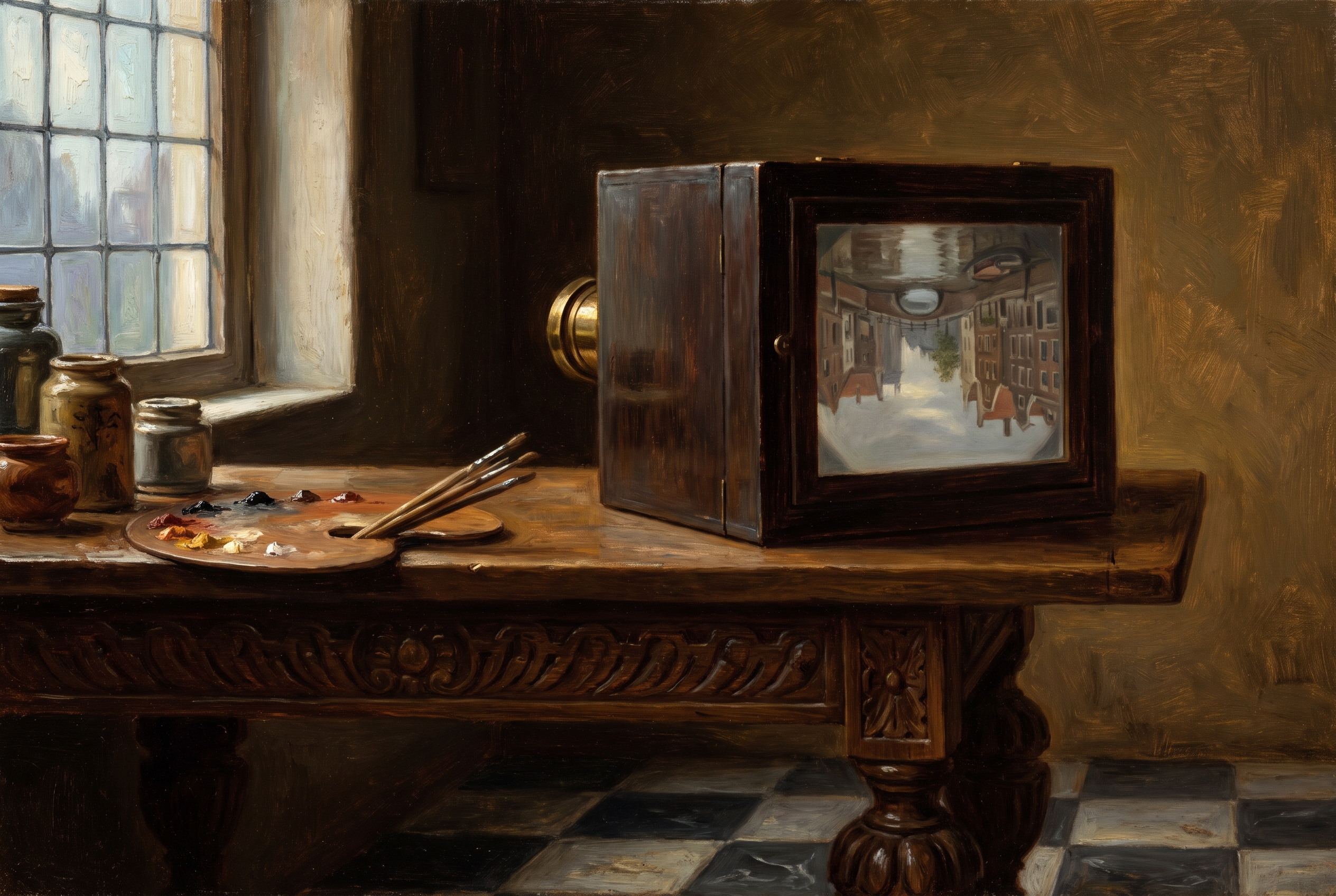
What a camera obscura is
The principle is ancient and requires no technology at all. Make a small hole in the wall of a dark room and the scene outside will appear, inverted, on the opposite wall. Add a lens in the hole and the image becomes brighter and sharper, with a shallow depth of field: one plane crisp, everything nearer or further softened.
By Vermeer's lifetime these were well known instruments, sometimes room-sized, sometimes portable boxes and tents. This was the century of Dutch lens grinding. Antonie van Leeuwenhoek, who made microscopes good enough to see bacteria, lived in Delft, was born the same year as Vermeer, and served as executor of his estate. The two men almost certainly knew each other. That coincidence has done a great deal of work in this argument, and it should be said plainly that a coincidence is not evidence of a working method.
The clues in the paintings
- Pointilles. Small circular blurred highlights, scattered on bread, on brass nailheads, on a woman's hat. They resemble the way an unfocused lens renders a specular point.
- Selective focus. In several paintings a foreground object is soft while the middle distance is sharp. Eyes do not work this way, because we refocus constantly and remember the world as uniformly clear. Lenses do work exactly this way.
- Photographic tonal relationships. Vermeer sometimes lets a shadow swallow detail rather than describing what he knows is inside it, closer to how film behaves than how a painter of his era normally reasoned.
- Uncanny perspective and scale. The geometry of his rooms is extremely consistent, and the size relationships between near and far objects are unusually exact.
- Almost no drawing underneath. Technical examination finds little of the preparatory underdrawing typical of the period, which invites the thought that he was tracing or matching something already in front of him.
Taken together it is a suggestive pile. Individually, each item has an alternative explanation, and that tension is the whole debate.
The Hockney and Falco thesis
The painter David Hockney argued in Secret Knowledge that optical devices were used far more widely across European art than the record admits, and that the sudden arrival of a certain kind of exactitude marks the moment lenses and mirrors entered studios. The physicist Charles Falco worked with him on the optical analysis. Vermeer became the obvious exhibit for the argument.
Then in 2013 the film Tim's Vermeer took the question into the workshop. Tim Jenison, an engineer with no painting training, built a setup using a camera obscura with a mirror comparator and spent years producing a version of The Music Lesson. He got a remarkably convincing result. The film is genuinely fascinating and it proves something specific: the method is possible, and it can carry an untrained hand a long way.
It does not prove Vermeer used it. Demonstrating that a route exists is different from showing it is the route someone took, and that distinction is where much of the argument gets lost.
The case for the sceptics
- 1No documentary trace. Not a mention in any surviving letter, inventory or contemporary account. Devices were not secret or shameful in the seventeenth century, so silence is at least mildly awkward for the theory.
- 2No lens in the estate inventory. When Vermeer died, his possessions were listed. No camera obscura, no lens. Lenses were valuable and would plausibly have been recorded, although the inventory is not exhaustive and debts were being settled in a hurry.
- 3Painters could already do this. Perspective construction using a pin, thread and vanishing point was standard practice, and studies of Vermeer's canvases have found evidence consistent with exactly that: a small hole at the vanishing point in several works. That is a mechanical aid, but it is drawing, not optics.
- 4Traced images would not look like this. A projected image is dim and fugitive, and the palette Vermeer used includes colours a camera obscura would not have shown him. The paintings also contain compositional edits, objects moved or removed, which a faithful tracing would not require.
- 5The effects can be chosen. A painter who had looked through a lens might well adopt its aesthetic without painting through it. Learning that light behaves in a certain way is not the same as outsourcing your hand to a machine.
The most common position among specialists today is somewhere in the middle: Vermeer probably looked through a camera obscura, was influenced by what he saw there, and painted with his own eye and considerable geometric skill. It is a less thrilling answer than either extreme, and it fits the evidence best.
Why it matters, and why it does not
The reason some people find the question threatening is that it seems to touch genius. If the machine made the picture, what was Vermeer for? That framing misunderstands both painting and tools. Nobody thinks less of an architect for using a straight edge. Composition, colour, the decision about which fraction of a second in a quiet room deserves to be permanent: none of that is delivered by a lens.
The reason the question is genuinely interesting is what it reveals about how art historians reason. They are working from a handful of paintings, one inventory, and physical evidence in the paint itself. They cannot ask him. So they build competing explanations, test each against pigment analysis and infrared scans, and hold the verdict open. That is the same discipline of looking closely and asking what would have to be true that we lay out in how to read a painting.
The world he worked in
None of this happened in isolation. Delft in the 1660s sat inside an economy so rich that ordinary merchants bought pictures for their walls, which is why so much Dutch painting of the period is of kitchens and letters rather than saints and kings. That market, and the trade wealth behind it, is the subject of the Dutch Golden Age explained.
It is also the era of the painter one street over in art history's memory, and if you want the full narrative of the period's other great manipulator of light we tell it in Rembrandt's Shadow. Vermeer and Rembrandt were solving the same problem, how to make paint behave like light, from opposite ends: one with meticulous cool geometry, one with heat and shadow. Neither answer needed the other.
As for the pearl, the most famous object in his work, its own peculiar afterlife is worth its own story: we tell it in why Girl with a Pearl Earring is so famous.
Where the question stands
Open. Probably permanently, unless a document turns up in an archive nobody has read yet, which does occasionally happen. In the meantime the honest sentence is that Vermeer painted as though he had seen the world through a lens, and we do not know whether he was tracing it or remembering it. The paintings are unchanged either way, which is a hint about how much the answer really matters.
Frequently asked questions
One snap tomorrow morning.
Two minutes in art, history, psychology, philosophy or economics, then the app tells you you're done.
Get MindSnap on iOSFree daily fact, forever. Pro is $9.99/month or $44.99/year.