The Strange Origins of Everyday Superstitions

Curiosity Columnist
Last updated: August 2026
7 min read

TL;DR
Most everyday superstitions have murkier origins than the confident stories told about them. Spilled salt really does trace back to a time when salt was precious. Avoiding ladders makes practical sense and may have picked up darker associations with the gallows. Black cats became sinister through their link to witchcraft in parts of Europe, yet they are lucky in others. Blessing a sneeze is far older than the famous plague-pope story. Knocking on wood and the seven years of bad luck for a broken mirror have popular explanations with thin evidence, and Friday the 13th as a combined fear seems to be surprisingly modern. Superstitions survive because they are sticky stories that feed our pattern-seeking brains.
Here is a confession: I knock on wood. I know it does nothing. I have read about it. I still do it, usually on my own head when no table is nearby, which my family finds hilarious.
Superstitions are a lovely category of history, because almost everyone practices one and almost no one knows where it came from. Worse, many of the origin stories that circulate online are folklore about folklore. So let us take the big ones in turn, and I will flag where the popular explanation is itself a myth.
Knocking on wood
The story you will hear most often is that ancient pagans knocked on trees to wake protective spirits living inside, or to stop evil spirits from overhearing your good luck. It is a charming idea. The problem is that there is little direct evidence connecting those beliefs to the modern habit.
Folklorists note that the phrases "touch wood" and "knock on wood" are only well documented from around the 19th century. One suggestion links them to a children's chasing game in which touching wood made you safe. Another links it to Christian wooden crosses. The honest answer is that nobody is sure, and the tree-spirit version is best treated as a guess that became a fact through repetition.
Spilled salt
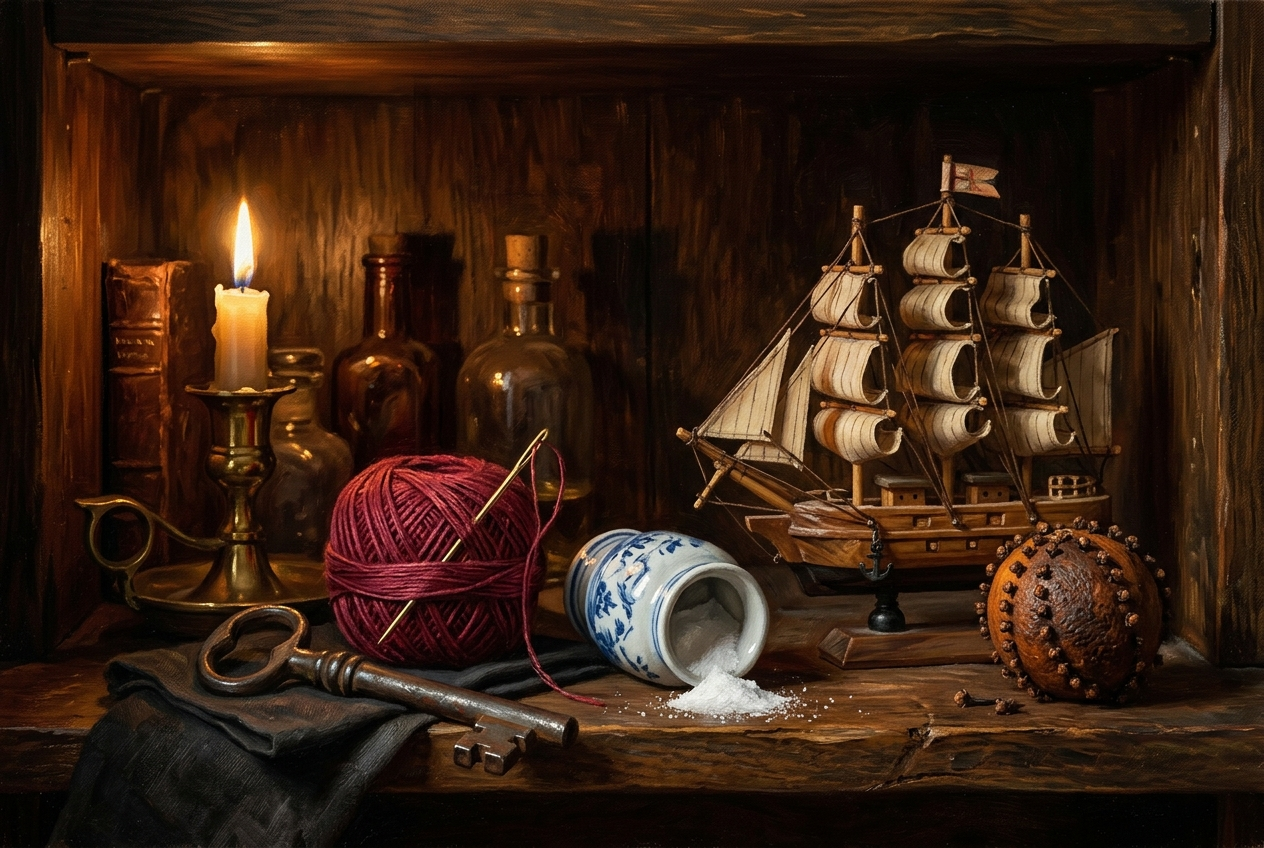
This one has a solid foundation. For most of history salt was valuable: it preserved food, it was taxed heavily in many places, and wasting it was a real loss. Treating a spill as bad luck makes economic sense.
Throwing a pinch over your left shoulder is harder to pin down. A common explanation says it blinds the devil lurking there, which fits a long tradition of the left side being associated with bad omens. Leonardo da Vinci's The Last Supper is often cited because it shows an overturned salt cellar near Judas, though whether Leonardo meant it as a symbol is debated. Salt is also central to language, as I mention in everyday words with surprising origins.
Walking under ladders
You may have read that a ladder against a wall forms a triangle, a symbol of the Holy Trinity, and that walking through it was blasphemous. It is a neat story, but it appears mostly in modern retellings with little early evidence behind it.
The more grounded explanations are simpler. Walking under a ladder is genuinely risky: things fall, people fall, and you might knock the ladder over. Some historians also point to the ladders used at gallows, which would have given the shape grim associations. Practical caution plus a dark image is a strong recipe for a superstition.
Broken mirrors and seven years of bad luck
The usual claim is that ancient Romans believed a mirror held part of your soul and that life renewed every seven years, so a broken mirror meant seven years of misfortune. You will see this repeated everywhere, but solid ancient sources for the specific seven-year rule are hard to find.
What we can say is that mirrors and reflective surfaces have been linked to the soul and to divination in many cultures, and that glass mirrors were expensive for a long time. Breaking something costly and personal was bad luck in the most literal sense. The tidy seven-year number looks like a later addition.
Black cats
In parts of medieval and early modern Europe, cats, and black cats in particular, became associated with witchcraft and the devil. Witch trial lore sometimes described animal companions called familiars, and a black cat slipping through the dark fit the role perfectly.
But this is a regional belief, not a universal one. In Britain and Ireland a black cat crossing your path has often been considered lucky, and in Japan black cats have traditionally been seen as charms of good fortune. Ancient Egypt, famously, revered cats in general. So whether a black cat is a curse or a blessing depends mainly on where your great-grandparents lived.
"Bless you" after a sneeze
The most famous origin story credits Pope Gregory I, who supposedly ordered people to bless sneezers during a plague outbreak in Rome around the year 590. Gregory did lead Rome during an epidemic, but the specific link to sneezing appears in later sources, and the custom is clearly older.
Roman writers, including Pliny the Elder, already mention responding to sneezes with a wish or blessing, and similar customs exist in many languages and religions. The impulse is easy to understand: a sneeze is sudden, involuntary and sometimes a sign of illness. Saying something kind afterward is a small ritual of protection, which is exactly what superstitions are.
Unlucky 13 and Friday the 13th
Fear of the number 13 has several proposed roots. Twelve is a neat, complete number in many systems: months, zodiac signs, apostles, hours on a clock face. Thirteen breaks the set. The Last Supper had thirteen people at the table, and a Norse myth tells of Loki arriving as an unwanted thirteenth guest at a feast that ended in tragedy.
Friday was considered an unlucky day in some Christian traditions, being the day of the crucifixion. You will often read that the Knights Templar were arrested on Friday 13 October 1307, which is true, and that this created the superstition, which is not supported. The combined fear of Friday the 13th seems to have become widespread only in the late 19th and early 20th centuries, helped along by popular fiction. It is younger than many buildings that skip a 13th floor.
Why superstitions stick
If most of these origins are fuzzy, why do the habits survive so well? Two reasons stand out. First, they are sticky stories: short, vivid, emotional and easy to pass on. A black cat, a broken mirror and a dramatic origin tale are far more memorable than a dry fact. Second, our brains are pattern-seeking machines. Remember the one bad day after you walked under a ladder and you forget the hundred normal ones.
That is also why invented explanations spread. A good origin story is itself a sticky story, which is the same mechanism behind famous quotes that were never said. And our units of measurement have equally odd beginnings, as I found in the strange origins of everyday measurements.
Swap folklore for the real thing
If you love this kind of curiosity, the good news is that real history is just as strange as the folklore and much more satisfying to repeat at dinner. MindSnap is our app, and it sends a free daily fact plus two-minute lessons across five flagship story-driven collections and unlimited topics. Two minutes of real trivia a day is a better habit than knocking on your own head, though I am not promising to stop.
Frequently asked questions

One snap tomorrow morning.
Two minutes in art, history, psychology, philosophy or economics, then the app tells you you're done.
Get MindSnap on iOSFree daily fact, forever. Pro is $9.99/month or $44.99/year.