Chapter 1 of 8
The gadfly of Athens
A stonemason's son who spent his days in the marketplace asking people what they meant, and compared himself to a fly keeping a large slow horse awake.
2 min read
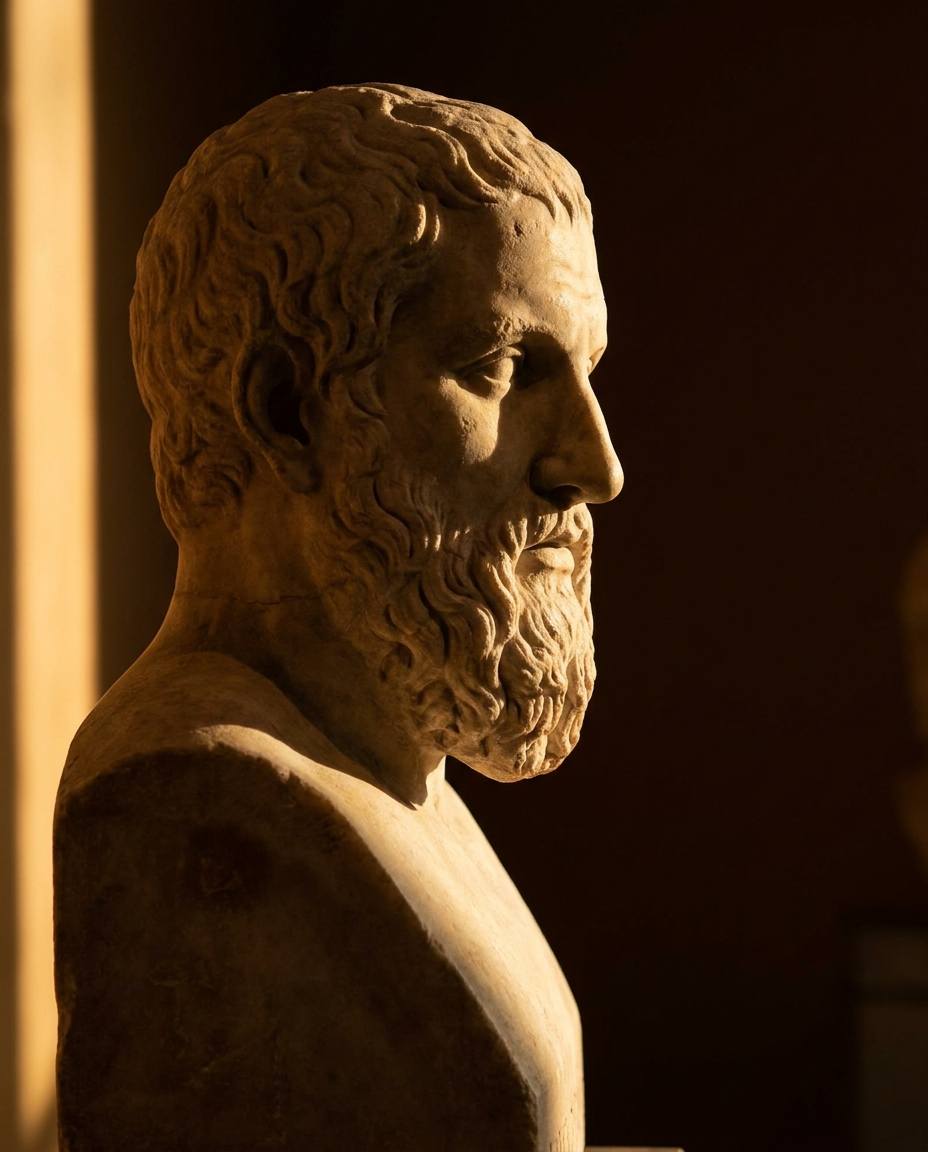
Socrates was born in Athens around 469 BC, the son of Sophroniscus, described in the tradition as a stonemason or sculptor, and Phaenarete, a midwife. He served as a hoplite in the long war against Sparta and was remembered for physical toughness on campaign. He held no office beyond one turn on the council. He charged no fees, ran no school, and left no writing of any kind.
That last fact governs everything that follows. Everything attributed to him comes through witnesses. Plato, who was in his twenties when Socrates died, wrote dialogues in which Socrates is the leading speaker, and made him the mouthpiece for ideas that were probably Plato's own as the work went on. Xenophon, a soldier and gentleman farmer, wrote a plainer, more practical Socrates who gives advice about household management. Aristophanes, in the comedy Clouds of 423 BC, put a Socrates on stage in a hanging basket studying the heavens, running a school for teaching people how to argue out of their debts. Aristotle, a generation later, reports what the schools remembered. These portraits do not agree, and the honest position is that we know a method and a temperament rather than a man.
What all the sources place in the same location is the daytime. He was in the agora, the workshops, the wrestling grounds and other people's dinner parties, talking. His companions included ambitious young aristocrats, among them Alcibiades and later Plato, and also craftsmen and visitors. This mattered politically, because in a small city the sight of an older man permanently surrounded by the sons of powerful families invited a specific suspicion about influence.
His own image for what he did, as Plato gives it in the Apology, is the gadfly. Athens is a large and well-bred horse, sluggish because of its size, and he is the fly that stings it into wakefulness. It is a flattering comparison from the fly's point of view and an annoying one from the horse's, and it captures the problem exactly. He did not offer doctrines that could be accepted or rejected. He asked people who were confident to explain themselves, in public, in front of the young men who admired them, and the explanations tended not to survive.
There is no mystery about why that made enemies. The interesting question is what the procedure actually looked like, and it is easier to show than to describe.
Keep going
Liked making the call?
MindSnap delivers a 2-minute turning point like this every day, plus a lesson, a quiz and a daily fact.
Free daily fact · price shown up front · cancel in one tap