Chapter 4 of 8
The Wednesday Society
From 1902, four doctors met in Freud's waiting room every Wednesday evening. Within a decade the group had become an international movement, and had learned how to expel people.
2 min read
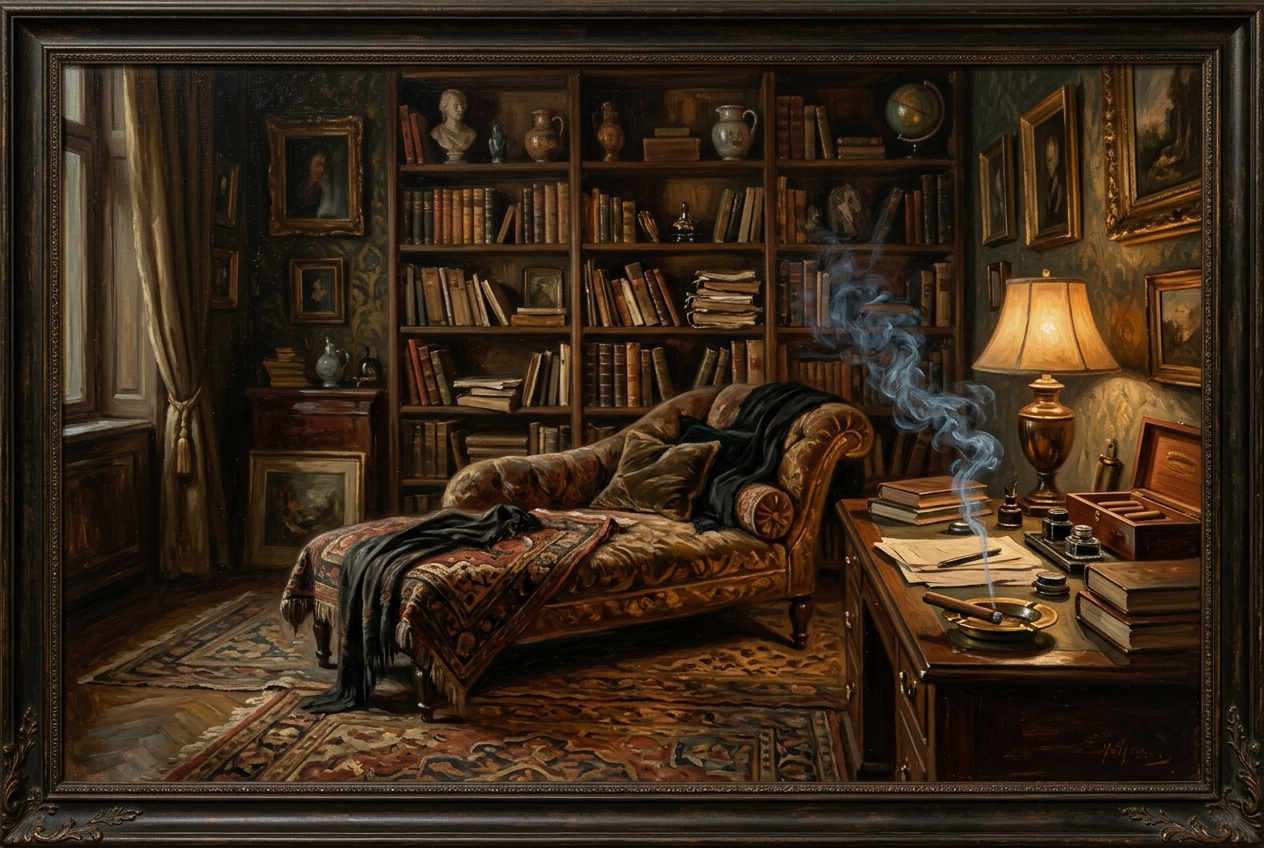
In the autumn of 1902 Freud invited four Viennese physicians to discuss his ideas at his apartment on Wednesday evenings. Wilhelm Stekel, Alfred Adler, Max Kahane and Rudolf Reitler came to the waiting room at Berggasse 19, sat among the antiquities Freud collected obsessively, and talked. Coffee and cigars, one paper, then discussion in a fixed order round the table. They called themselves the Wednesday Psychological Society.
It grew. Otto Rank was hired as secretary and kept minutes, which is why we know more about these evenings than about most private seminars in history. Sándor Ferenczi arrived from Budapest, Carl Gustav Jung and Karl Abraham from the German-speaking world beyond Austria, Ernest Jones from Britain. In 1908 the group renamed itself the Vienna Psychoanalytic Society. In 1910 the International Psychoanalytical Association was founded, with Jung as its first president. In eight years a waiting-room discussion had become an institution with branches.
The social form is worth noticing, because it shaped the intellectual form. Psychoanalysis was not tested in laboratories or teaching hospitals. It was developed in a private circle, transmitted by apprenticeship, and validated by the judgement of senior practitioners, with Freud's own judgement at the centre. Training required being analysed yourself by someone already inside the circle. That produced extraordinary loyalty and a real body of clinical craft. It also meant disagreement about theory could not easily be settled by evidence, so it was settled by authority.
The first serious break came with Adler, one of the original four. Adler argued that the driving human motive was not sexuality but a striving to overcome inferiority, and that social conditions and the will to power mattered more than infantile drives. Freud treated this as a defection rather than a hypothesis. In 1911 Adler resigned as president of the Vienna society and left with a small group of supporters, founding his own school of individual psychology, which went on to influence education, parenting and later cognitive approaches.
Stekel left the same year. Rank and Ferenczi, both closer to Freud than almost anyone, would eventually be pushed to the margins too. A pattern was established early: brilliance recruited, then disciplined.
None of that stopped the movement spreading. By the First World War there were psychoanalytic societies in Berlin, Budapest, London, Zurich and New York, a journal, a publishing house, and a vocabulary that was leaking into novels, painting and criticism faster than into medicine. Freud lectured in the United States in 1909 at Clark University and found himself, to his surprise, famous there.
The most gifted of the recruits was the man in Zurich, whom Freud had privately marked out as his successor. That relationship was about to break in public.
Keep going
Liked making the call?
MindSnap delivers a 2-minute turning point like this every day, plus a lesson, a quiz and a daily fact.
Free daily fact · price shown up front · cancel in one tap