Chapter 7 of 8
Exile: a last year in London
In March 1938 German troops entered Austria. Freud was eighty-one, ill with cancer, and reluctant to leave Vienna. It took a ransom, a princess and a diplomatic campaign to get him out.
2 min read
Freud had been ill for fifteen years. In 1923 a growth in his mouth was diagnosed as cancer, the result of a lifetime of cigars, and from then on he lived through a long series of operations and wore a prosthesis in his upper jaw that made eating and speaking difficult. He kept working, kept seeing patients, and kept writing, including the late books on religion and civilisation that reach well beyond the clinic.
In March 1938 Germany annexed Austria. Crowds cheered in Vienna, Jewish shops were looted, and Jewish citizens were beaten in the streets and made to scrub pavements. The Gestapo searched Berggasse 19 and confiscated money. Freud's daughter Anna, by then his closest colleague and the person who would carry his work forward, was summoned for interrogation and released after a day. Books by Freud had already been burned in Germany in 1933.
He still resisted leaving. It took his doctors, his publisher, his followers abroad and considerable diplomatic pressure to change his mind. The exit required paying the Reich flight tax, which was covered largely by Marie Bonaparte, a French princess and psychoanalyst, and the intervention of figures including the American diplomat William Bullitt and the head of Freud's British publisher. Before he was allowed to go the authorities required a signed statement that he had been treated correctly. Reports circulated afterwards that he had asked to add a sarcastic recommendation of the Gestapo, though the story is probably apocryphal.
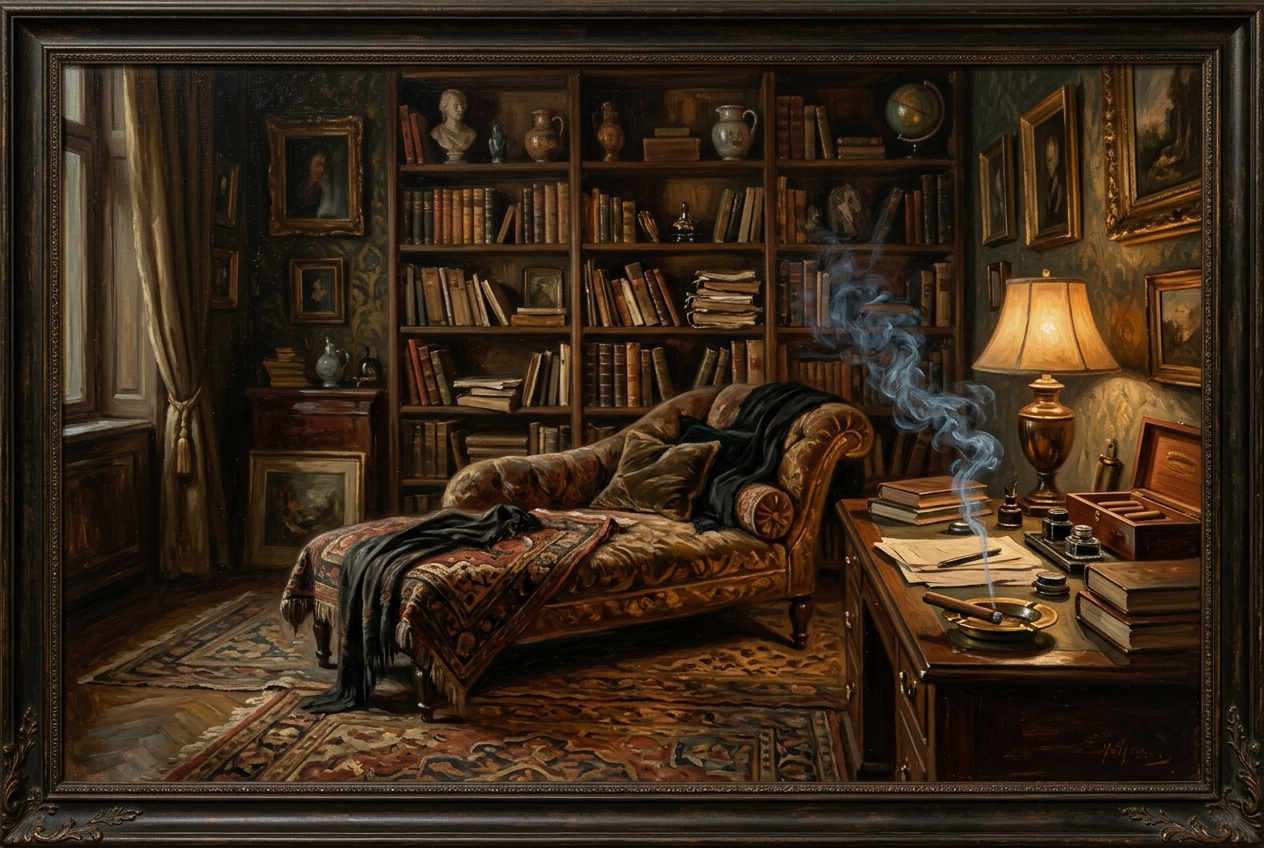
In June 1938 Freud left Vienna by train with Anna, his wife Martha, and a small group of family and household. They travelled through Paris to London and settled at 20 Maresfield Gardens in Hampstead, where his consulting room was reassembled with the couch, the rugs and the whole crowded shelf of Egyptian, Greek and Roman figures he had spent forty years collecting. The house is now a museum, and the antiquities are still on the desk.
Four of his elderly sisters could not get out. They died in Nazi camps in 1942 and 1943.
London received him as a monument. H G Wells campaigned for his naturalisation, the Royal Society sent its charter book to be signed at his bedside, and Salvador Dalí came to sketch him. He finished the book on Moses that had occupied him for years. The cancer spread into his cheek and became inoperable and, by the accounts of those present, unbearable. On 21 September 1939, with the Second World War three weeks old, he reminded his physician Max Schur of an old agreement. Schur administered doses of morphine, and Freud died on 23 September at eighty-three.
His ideas outlived his evidence, and the twentieth century was already speaking a language he had invented.
Keep going
Liked making the call?
MindSnap delivers a 2-minute turning point like this every day, plus a lesson, a quiz and a daily fact.
Free daily fact · price shown up front · cancel in one tap