Chapter 5 of 8
Turing, and the machine that hunted machines
Alan Turing's answer was not to guess the setting. It was to build a device that eliminated wrong settings faster than any human could test them.
2 min read
Alan Turing arrived at Bletchley the day after Britain declared war. He was twenty-seven, a fellow of King's College Cambridge, and already known for a 1936 paper on computable numbers that described an abstract machine capable of carrying out any well-defined procedure. That paper was pure logic with no hardware attached. What he did next was engineering with a deadline.
The insight was to stop looking for the right answer and start eliminating wrong ones. Suppose you guess that a particular stretch of intercepted message contains a known phrase, a crib. German signals were formulaic: weather reports, routine returns, the phrase meaning nothing to report. Line your crib up against the ciphertext, using the fact that no letter encodes as itself to throw out impossible alignments, and you have a hypothesis about which plaintext letters correspond to which cipher letters.
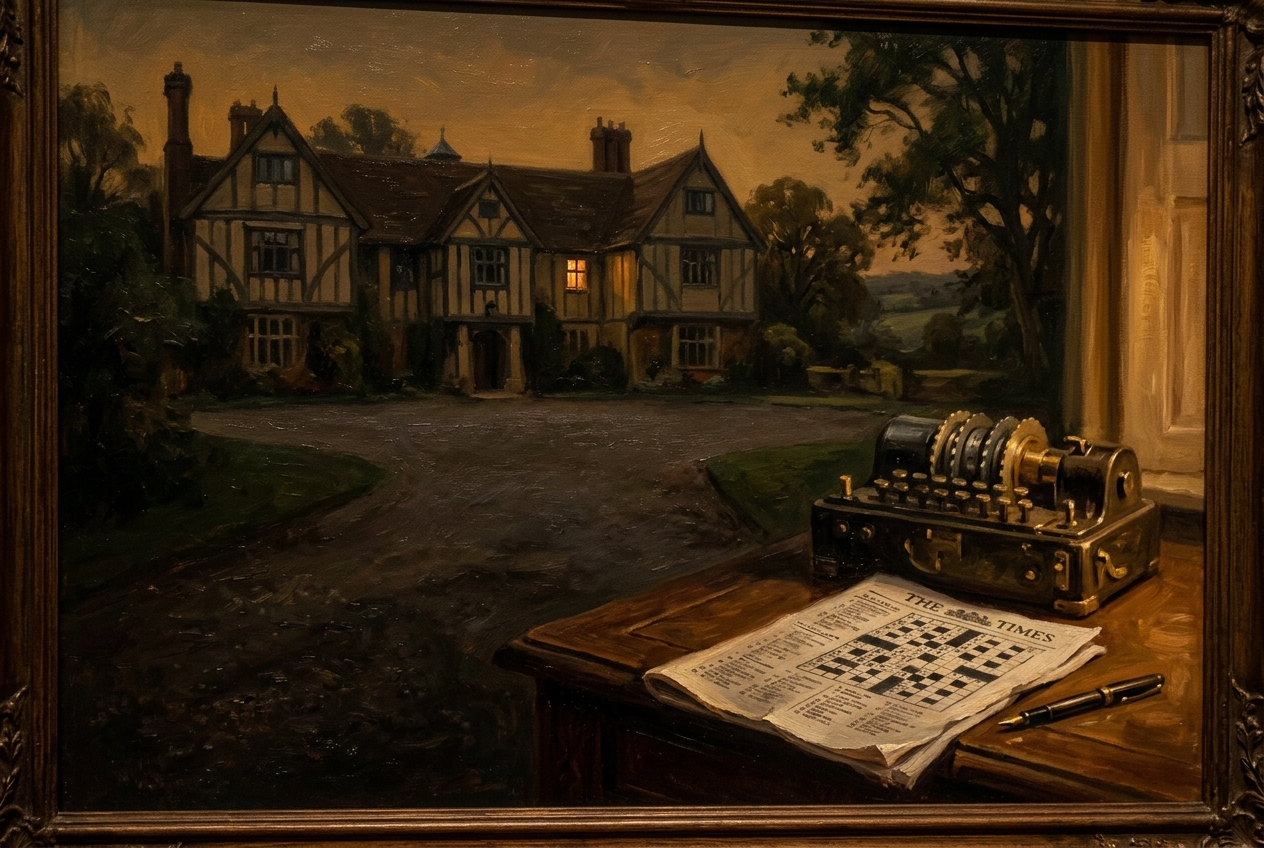
Now the mechanism. Each hypothesis implies a chain of electrical consequences through the rotors. If you assume a particular rotor setting and a particular plugboard connection, that assumption forces other connections. Follow the chain far enough and it will usually contradict itself. A contradiction proves the setting wrong, and lets you discard it and move on. The Bombe, built to Turing's design by the British Tabulating Machine Company under Harold Keen, was a cabinet of rotating drums that tested these chains at electrical speed and stopped when it found a configuration that did not contradict itself.
The crucial improvement came from Gordon Welchman, a mathematician running Hut 6. His diagonal board exploited the fact that plugboard connections are reciprocal: if A is wired to N, then N is wired to A. Feeding that symmetry into the machine multiplied the number of deductions each hypothesis produced, and cut the number of surviving false stops dramatically. Without it the Bombe would have been useful. With it, the attack became practical at wartime volume.
None of this was automatic. Each Bombe run needed a good crib, which needed skilled guesswork about German habits, and every stop had to be checked by hand on a replica machine. The machines were noisy, hot, oily, and operated in shifts around the clock, largely by Wrens who were told what to set and nothing about why. By 1945 more than two hundred Bombes were running in Britain, most of them at outstations rather than Bletchley itself.
The method worked across many networks. But one network resisted, and it was the one that mattered most to a country dependent on food and fuel arriving by sea.
Keep going
Liked making the call?
MindSnap delivers a 2-minute turning point like this every day, plus a lesson, a quiz and a daily fact.
Free daily fact · price shown up front · cancel in one tap