Chapter 7 of 8
Why his late self-portraits still stare back
Around forty painted faces across forty years, and the last of them are the least flattering and the hardest to leave.
2 min read
Rembrandt painted his own face roughly forty times, and drew and etched it many times more, from the bug eyed experiments of his early twenties to the last canvases of 1669, the year he died. No painter before him had left a comparable record of a single face ageing. It was not one project. Early on the self-portraits were technical practice and advertising. Late on they became something else.
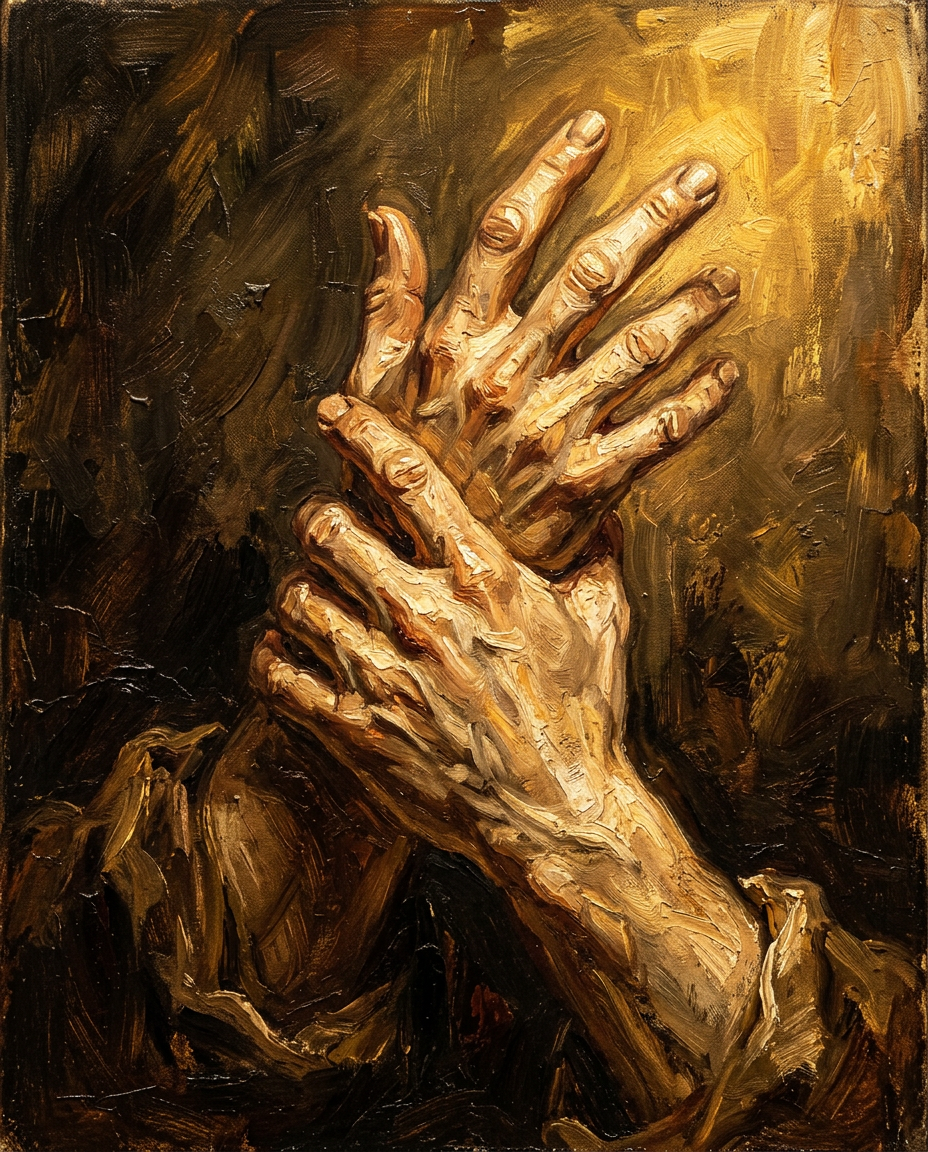
The change is easiest to see in the hands and the edges. In the confident middle years he liked costume: a gold chain he had no right to wear, a beret, a fur collar, the props of a successful man. In the final decade the costume mostly goes. What is left is a heavy face, a red nose, thin hair under a plain cap, and a body that has stopped performing. In one late portrait he holds a palette and brushes and the working hand is barely described at all, a few strokes of brown, while the face is built up in ridges of thick paint.
That imbalance is the point. He spends the material where he wants your attention and lets everything else fall away, exactly as he had spent thirty years spending light. Up close the surface looks like weather. Step back three paces and it snaps into a specific person looking at you with an expression that resists being named. Not tragic, not serene, not asking for sympathy. Assessing.
The last years were not gentle. Hendrickje died in 1663. Titus, by then married, died in 1668, before his own child was born. Rembrandt died in October 1669 and was buried in an unmarked rented grave in the Westerkerk, which was common enough for someone of modest means and still a strange ending for the painter who had once been the most expensive in Amsterdam.
The temptation is to read the late faces as a confession of all that loss. It is safer, and more interesting, to read them as a working method taken to its limit. He had learned that a picture becomes convincing when most of it is sacrificed, and he applied that to himself with no client to please, no guild to flatter and nothing left to protect.
Which is also why they are so difficult to fake, and why forgers keep trying anyway.
Keep going
Liked making the call?
MindSnap delivers a 2-minute turning point like this every day, plus a lesson, a quiz and a daily fact.
Free daily fact · price shown up front · cancel in one tap