Chapter 5 of 8
Light as a weapon: chiaroscuro
Most painters lit a scene. Rembrandt decided what to hide, then lit only what was left.
2 min read
Chiaroscuro is simply the Italian for light and dark, and it names a way of building a picture out of the contrast between them rather than out of line. The idea was not Rembrandt's. Caravaggio in Rome had already made a career from bodies emerging out of blackness, and Dutch painters in Utrecht had brought a version of that style home after studying his work. What Rembrandt added was restraint about the source and generosity about the surface.
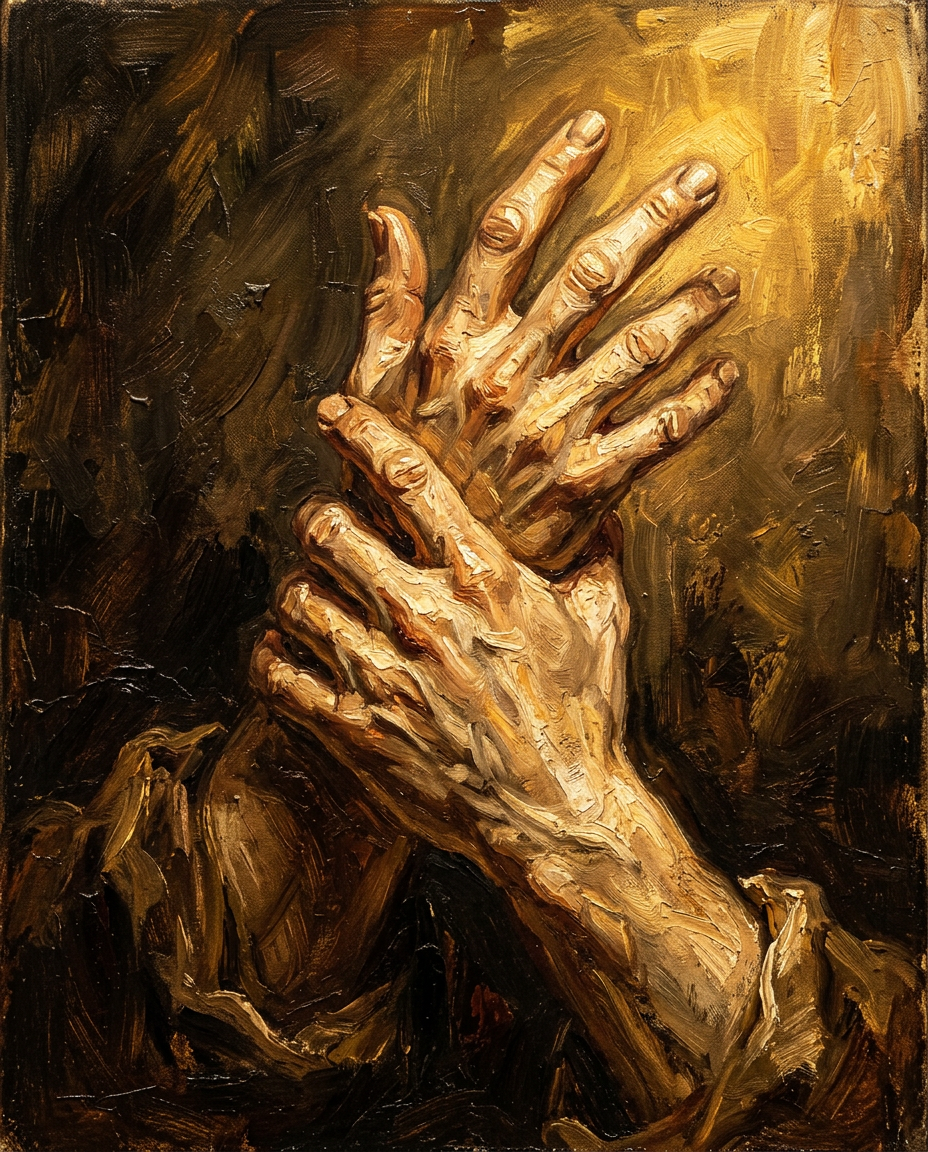
Look for the source first. In most of his mature paintings there is one dominant light, usually entering from the upper left, and it behaves consistently. It falls on a forehead, a collar, the back of a hand, the pages of a book. Everything it does not reach is not black but a warm brown gloom in which you can still make out furniture, a wall, a second figure. That gloom is doing structural work. It removes information, and by removing it, forces the eye to the three or four things he wants you to notice.
Then look at the paint itself. In the lit passages the surface is often built up thick, applied with a loaded brush and sometimes pushed around with the handle or a palette knife, so that the physical ridges of pigment catch the real light of the room you are standing in. A gold sleeve is not painted as a picture of embroidery. It is a crust of lead white and yellow, and at the correct distance the crust becomes embroidery. Shadows, by contrast, are thin, quick and transparent, laid over a warm ground.
This is also the logic of his etchings, where he had no colour at all. He would rework a plate through many states, deepening the darks with drypoint burr, printing on different papers, so that the same image could feel like early evening in one impression and midnight in the next. The subject stayed still. The lighting became the story.
Two practical habits come out of this. First, in any gallery, ask where the light in a painting is coming from and whether it is obeyed everywhere. Inconsistent light is the fastest way to spot a weak picture, or a later hand. Second, stand back further than feels natural, then walk in. Work built out of thick lit passages resolves at distance and dissolves up close, and that dissolving is not an accident of age.
Learning to read light this way takes minutes. MindSnap turns exactly that kind of habit into a two-minute lesson you can use the same afternoon.
It was also, unfortunately, a set of skills that did nothing to protect him from his own accounting.
Keep going
Liked making the call?
MindSnap delivers a 2-minute turning point like this every day, plus a lesson, a quiz and a daily fact.
Free daily fact · price shown up front · cancel in one tap